


Today, more than ever, companies that operate commercial motor vehicles need to prepare in advance for an accident involving one of their vehicles. Depending on the severity of the accident, the incident itself can be enough to throw the thought processes of most drivers and supervisors into disarray.
Companies need to have a clear, direct plan in place that can be implemented when an accident occurs. This plan must be flexible and capable of being activated at any time of the day or night.
When an accident occurs, the company has several immediate concerns that need to be addressed:
-
Ensuring the safety and protection of the driver and the public.
-
Protecting the company from liability and physical damage exposure.
-
Providing information to law enforcement officials.
-
Controlling additional damage that may result from the accident, including hazardous material spills and damage to cargo and vehicles.
-
Complying with state and federal regulations, such as drug and alcohol testing, when required.
-
Documenting and preserving physical evidence at the scene to prevent spoliation of evidence.
-
Identifying and securing witnesses to the accident.
-
Addressing the news media and social media.
-
Arranging to have the vehicle towed to a safe and secure location.
Recommendations for Companies Preparing for an Accident
-
Establish an accident response team. Ideally, this team should consist of the safety director, the driver involved, an insurance accident investigator, the company's attorney, and, if necessary, an accident reconstruction expert.
-
Develop an accident action plan. This plan should outline the roles and responsibilities of the response team.
-
Establish a written accident policy for drivers. Drivers should have clear instructions to follow when involved in an accident, regardless of its severity. This policy should address reporting procedures, conduct at the scene, responsibilities, drug and alcohol testing, and other relevant requirements.
-
Include accident scene training in your new driver orientation program. Drivers should know exactly what to do and what NOT to do in the event of an accident.
-
Place accident kits in vehicles. Each kit should include a camera, accident report form, pencil, and instructions. Place an expiration date on the outside of the kit that corresponds with the camera's expiration date, if applicable. It is recommended that these kits be sealed or secured to keep the materials together. Drivers should be trained on how to use the camera, including which photographs should and should NOT be taken.
Photographing an Accident Scene
The old saying, "A picture is worth a thousand words," is especially true when taking photographs at an accident scene.
Over the years, motor carriers have placed disposable film cameras in their trucks so drivers can document evidence at accident scenes. Today, with the evolution of digital cameras, it has become difficult to find locations that develop film.
Regardless of whether a driver uses a film or digital camera, have you provided training on how to operate it?
If not, you run the risk of drivers failing to take photographs needed to document important evidence. Worse yet, photographs taken improperly could potentially be used against your company in a court of law.
Use the following tips to train your drivers:
-
Show drivers how to properly operate the camera, if one is provided, or ensure they have access to a digital camera. Provide sample photographs to demonstrate the appropriate distance and angles for taking pictures.
-
If using a film camera, take all available photographs on the roll at the accident scene. If using a digital camera, make sure drivers understand the importance of taking plenty of photographs. That one additional photograph may contain key evidence that could help protect your company.
-
Photograph all damaged and undamaged areas of every vehicle involved. Do not forget to photograph each vehicle's license plate. The photograph should be close enough to clearly read the plate while also identifying which vehicle it belongs to. When possible, include the unit number in the photograph.
-
Photograph the interiors of the vehicles, including the dashboard and driver's compartment. Include safety equipment such as seat belts, steering wheels, pedals, and airbags.
-
Photograph the accident scene from all angles. When photographing a vehicle or the entire scene, imagine drawing a box around it. Then, take photographs from each corner of that imaginary box.
-
Take photographs of the roadway leading up to the accident scene. Photograph any skid marks from various angles. Include stationary objects such as telephone poles, road signs, buildings, and other relevant landmarks.
-
DO NOT take photographs of anyone who has been injured or killed in the accident. However, photograph occupants of other vehicles when appropriate to document who was involved in the accident. For example, if the driver of another vehicle is changing a tire, photograph this activity to document the driver's physical condition immediately following the accident.
Question of the Week
Question: I struck a deer on the roadway, and my vehicle is disabled. I have pulled the vehicle onto the shoulder. Where am I required to place my reflective triangles to alert other drivers?
Answer: First, immediately activate your four-way hazard flashers.
According to 49 CFR § 392.22:
"Whenever a commercial motor vehicle is stopped upon the traveled portion of a highway or the shoulder of a highway for any cause other than necessary traffic stops, the driver of the stopped commercial motor vehicle shall immediately activate the vehicular hazard warning signal flashers and continue the flashing until the driver places the warning devices (triangles)."
Next, place the reflective warning triangles as follows:
-
Place one triangle on the traffic side of the stopped commercial motor vehicle, approximately 4 paces (3 meters or 10 feet) away, in the direction of approaching traffic.
-
Place a second triangle approximately 40 paces (30 meters or 100 feet) from the stopped commercial motor vehicle, in the center of the traffic lane or shoulder occupied by the vehicle, in the direction of approaching traffic.
-
Place a third triangle approximately 40 paces (30 meters or 100 feet) from the stopped commercial motor vehicle, in the center of the traffic lane or
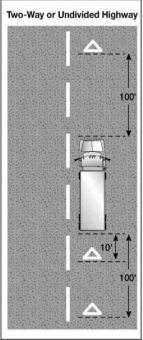
shoulder occupied by the vehicle, in the direction away from approaching traffic.
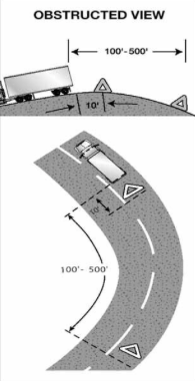
Hills, Curves, and Obstructions
If a commercial motor vehicle is stopped within 500 feet of a curve, the crest of a hill, or another obstruction that limits visibility, the driver must place a warning device in the direction of the obstruction, between 100 and 500 feet from the
stopped vehicle, to provide adequate warning to other highway users.
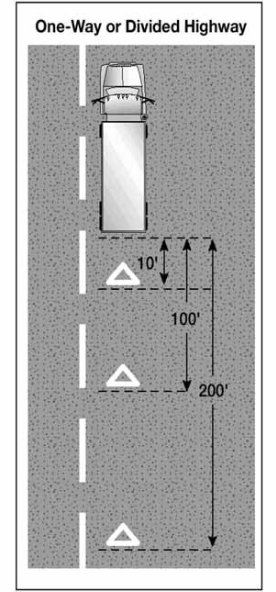
Divided or One-Way Roads
If a commercial motor vehicle is stopped on the traveled portion or shoulder of a divided or one-way highway, the driver must place warning devices as follows:
-
One warning device 200 feet from the vehicle in the direction of approaching traffic.
-
One warning device 100 feet from the vehicle in the direction of approaching traffic.
-
One warning device on the traffic side of the commercial motor vehicle, within 10 feet of the rear of the vehicle.
Checklists Assist Motor Carriers with Post-Accident Activities
There are often many details to address following a DOT-reportable crash. Use the following checklist as a starting point for your post-crash activities.
-
If your driver was injured, contact the driver's family, when appropriate, to offer assistance and reassurance.
-
Conduct any required post-accident drug and alcohol testing within the applicable 8-hour and 32-hour deadlines, as defined in § 382.303.
-
Contact your insurance agency. The agency can typically coordinate any necessary on-scene investigation for you and your attorney, if applicable, using its own personnel or a third-party adjuster.
-
Consider having an attorney oversee the investigation if you are concerned that the accident may lead to liability or additional investigation. Doing so can help ensure that evidence is properly preserved. Certain investigation materials may also be protected under the attorney work-product doctrine.
-
As applicable, preserve the following records for liability purposes:
-
The driver's files, including driver qualification and drug and alcohol testing records, as they existed on the day of the crash.
-
The vehicle files for all equipment involved, as they existed on the day of the crash.
-
Records of the driver's activities for approximately the previous 30 days or longer, including shipment paperwork, dispatch records, logs, payroll information, and other internally maintained documentation. If you are working with an attorney, they may request additional records.
-
-
If law enforcement conducts an extensive investigation, contact the investigating agency and provide the officer with your company's contact information.
-
Record the accident in your accident register in accordance with § 390.15.
-
Follow these best practices when law enforcement inspects the equipment as part of its investigation:
-
Request a copy of the inspection report as soon as it becomes available.
-
Arrange for an independent inspection. Insurance companies often have personnel available to conduct these inspections.
-
DOT Clarification Regarding Drivers Using Legally Prescribed Medications and the Medical Review Officer (MRO) During a Positive Controlled Substance Test
49 CFR §§ 40.135 and 40.327
QUESTION:
During the verification interview, the MRO may learn that an employee is taking a legally prescribed medication that could make the employee medically unqualified or pose a significant safety risk.
Section 40.135(e) requires the MRO to instruct the employee to have their prescribing physician contact the MRO to discuss concerns about the medication.
If the prescribing physician does not contact the MRO within five business days after the employee is instructed to make the request, the MRO will report the information about the legally prescribed medication to the appropriate third party.
Can the MRO report this information to a third party before the five-business-day period has elapsed?
ANSWER:
Yes. There are circumstances in which the MRO does not have to wait five business days before reporting the information. For example:
-
The prescribing physician speaks with the MRO before the five-business-day period has elapsed, and the significant safety risk remains unresolved.
-
The employee expressly declines to have their prescribing physician speak with the MRO.
Additionally, if the MRO learns during the verification interview of a medical condition or diagnosis that is likely to make the employee medically unqualified under a DOT agency regulation (e.g., FAA, FMCSA, or USCG), the MRO must report that information according to the procedures outlined in § 40.327.
The five-day waiting period under § 40.135(e) does not apply in these circumstances.
Got Chains?
If you operate in states that require tire chains to be carried on board, make sure your chains are the correct size, properly secured, clean, and free from damage so they can be easily installed when necessary.
Not sure what your state's tire chain laws are? Visit:


